
Concrete Protection
Why Minnesota Winters Destroy Unprotected Concrete (And What Actually Holds Up)
Every spring, Twin Cities homeowners walk into their garage and notice it: new cracks spidering across the slab, edges flaking, white salt stains that won't mop out. It didn't happen overnight. It happened one freeze-thaw cycle at a time, all winter long.
Minnesota winters don't make concrete's life easy — and unprotected concrete pays for it every single year. Here's what's actually happening to your floor, and what to do about it.
How Winter Attacks Your Concrete
1. De-icing salts work their way in. Concrete looks solid, but it's porous. Every time you pull into the garage, your tires carry in a slurry of road salt and meltwater. The salt migrates into the slab, and as it crystallizes it expands — breaking the concrete apart from the inside. That white, powdery staining on your floor is the visible sign of a deeper problem.
2. Freeze-and-thaw cycles widen everything. Water gets into tiny cracks and pores, freezes, expands by about 9%, and pries the crack a little wider. Then it thaws, more water gets in, and the cycle repeats — sometimes dozens of times in a single Minnesota winter. Small hairline cracks become spalling, pitting, and flaking edges.
3. Spring melt finishes the job. Months of trapped moisture and salt sit against the slab. When the big melt comes, the weakened surface layer lifts and flakes off. The damage you see in April was really done in January.
Why Generic Paint and Sealers Don't Cut It
A lot of homeowners try the hardware-store route: a coat of concrete paint, maybe a basic sealer. In a mild climate, that might buy you a season. In Minnesota, it's a short-term patch on a long-term problem.
Thin, generic coatings don't bond deeply enough to survive the expansion and contraction of a slab cycling between -20°F and 40°F. They peel, bubble, and delaminate — often within a single winter. And basic sealers wear off under hot tires and road salt long before spring.
The coating systems that hold up here aren't generic products. They're engineered to bond hard, flex with temperature changes, and resist the specific abuse that comes with living in this climate.
What Actually Holds Up
- Polyurea and polyaspartic flake systems — these cure fast, bond aggressively to properly prepped concrete, and stay flexible through temperature swings instead of cracking with them.
- Professional surface prep — the coating is only as good as what's underneath it. Mechanical prep (not just a pressure wash) is what lets an engineered system actually grip the slab.
- Slip-safe, UV-stable topcoats — traction additives keep the floor safe when it's wet, and UV-stable topcoats won't yellow or fade, even on sun-exposed aprons and patios.
- An in-house crew that warranties the work — a coating is a system, not a product in a bucket. Who installs it matters as much as what's in it.
The Bottom Line
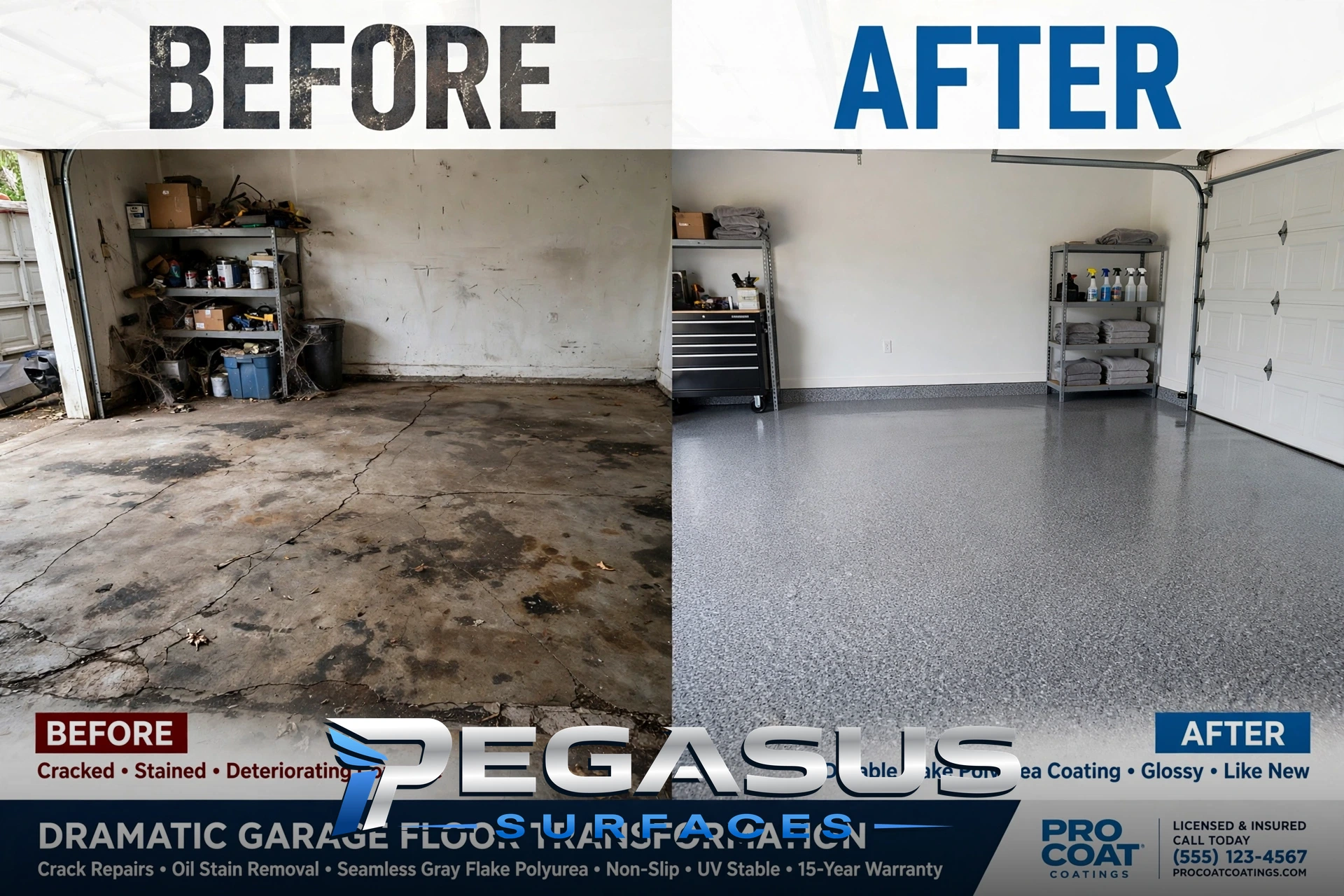
Unprotected concrete in Minnesota isn't a cosmetic issue — it's a countdown. Every winter of salt and freeze-thaw makes the next repair bigger and more expensive. A professionally installed coating system stops the cycle: it seals out salt and moisture, flexes with the slab, and cleans up with a mop instead of a pressure washer.
If your garage floor is showing salt damage, staining, or cracking, winter is already doing its work. The fix is straightforward — and most residential floors are done in a single day.
Get Your Free Concrete Coating Estimate
Talk directly with the crew that installs the job — no subcontractors, ever.
Call (651) 447-8234